
Alamo Personnel - The 1841 Alamo Monument
Alamo Personnel - the 1841 Alamo Monument
Previous: Alamo Personnel - Contemporary Casualty ListsNext: N/A
Introduction
The first Alamo monument was constructed in 1841. On it were engraved 166 names of men who were believed to have been Texian soldiers killed in the Battle of the Alamo on March 6, 1836. The monument stood in the halls of the state capitol at Austin. It was ruined in a fire in 1881 and was dismantled. This article describes the monument, presents the list of names carved on it, and compares its list of names with other early Alamo casualty lists, as well as with the list of Alamo defenders as is best known as of this writing.
Construction of the Monument
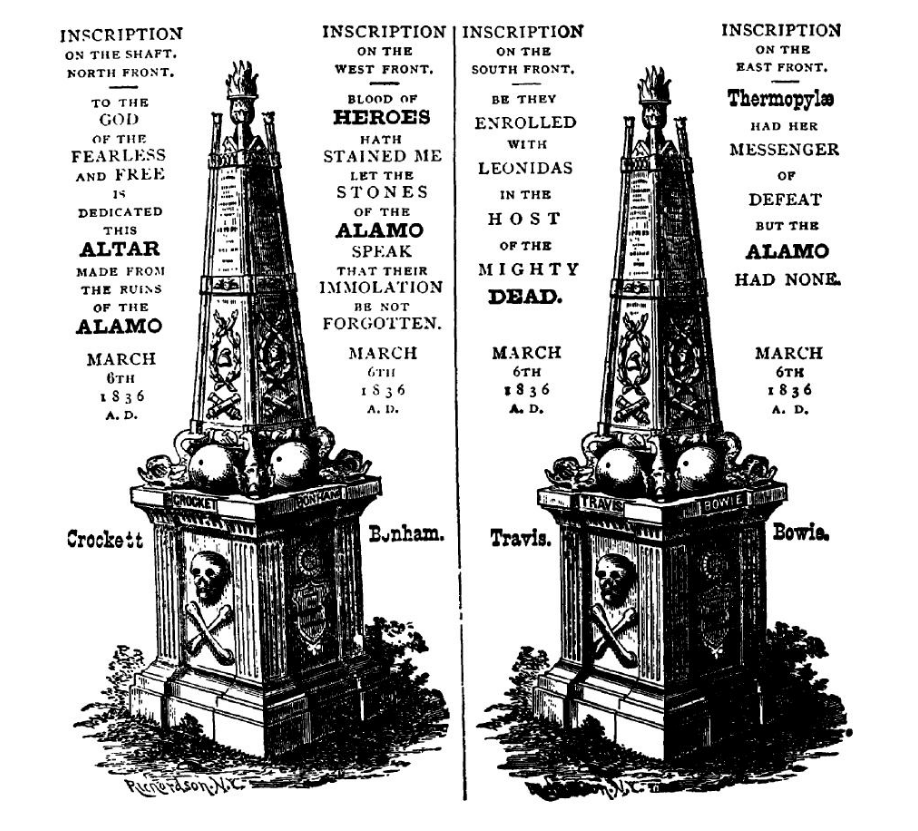
The monument was constructed in San Antonio in 1841 from ruins of the Alamo by a German named Nangle. It stood ten feet tall. It had a square footprint. It was finely engraved, in a mixture of Corinthian, Gothic, and other styles. Its symbols included shields, wreaths, vines, honeysuckles, skulls and crossbones, angels blowing trumpets, hourglasses, scythes, wings, oak leaves, dolphins, clasped hands, cannons, laurel branches, hearts pierced with daggers, bombshells, lone stars, funeral urns, and flames.
Each side of the monument featured a unique inscription:
- North: "To the God of the fearless and free is dedicated this altar made from the ruins of the Alamo."
- West: "Blood of heroes hath stained me. Let the stones of the Alamo speak that their immolation be not forgotten."
- South: "Be they enrolled with Leonidas in the host of the mighty dead."
- East: "Thermopylae had her messenger of defeat but the Alamo had none."
Additionally, each face bore an inscription reading "March 6th 1836 A.D." and had one Alamo defender's name carved in large letters: CROCKETT (north), BONHAM (west), TRAVIS (south), and BOWIE (east).
Last but not least, the north and south faces each bore the names of 81 men, as shown below.
Nangle made the monument on his own initiative with the plan of selling it to the Republic of Texas. The government did not buy it, however, and Nangle died. His business partner, an Englishman named Joseph Cox, then brought the monument to Houston in 1842 and put it on exhibit there and in Galveston for an admission price of 25 cents. At some point, Cox gave up on exhibiting the monument, and it found its way to a stonecutter's residence in New Orleans. A chance inquiry by a New Orleans resident in 1851 led to renewed interest in it. The Texas legislature passed an act in 1858 authorizing $2,500 for the monument's purchase: $1,000 to the owners and $1,500 to Nangle's widow. As of 1860, the monument was on display in the state capitol building in Austin. It was severely damaged in the capitol fire of 1881 and was dismantled. The tablets containing the names were said to have been unharmed and placed in storage. No one has reported seeing them since.
The Names on the Monument
The table below shows the names on the 1841 monument as they appear on page 113 of A Texas Scrap-Book by D. W. C. Baker, which is the only surviving record of the names. We have made three modifications to Baker's presentation. First, in A Texas Scrap-Book, the names are printed using both large and small capital letters; i.e. "small caps." For example, the first name is printed as M. Autry. We have presumed that the letters were actually carved on the monument in a uniform size and that the small caps were a stylistic choice made by Baker or his publisher. Second, Baker's list includes commas after every name and a period after the last name, Warner. We have presumed that the commas and period were not actually carved on the monument. Finally, Baker included an indication that E. Taylor, G. Taylor, and J. Taylor (but not W. Taylor) in the fourth column were "Bros.," or brothers. While that notation does seem to be correct, it is not represented in the table below.
The names below are spelled exactly as they appear in A Texas Scrap-Book. There are many misspellings, many of which were probably on the monument itself. It is also possible that Baker introduced some misspellings of his own. You can see the correct spelling of names by hovering over them.
The following symbols are used:
K Killed in the battle of the Alamo (as recognized by TexasCounties.net)
D Duplicate
Hyperlinked names match a name on an earlier Alamo casualty list.
Large Names Carved on Each SideNames Carved on the North and South Faces
Analysis of the Names
Most of the information we have about this monument comes from historian Reuben M. Potter, who mentioned it in an article in 1860 and further discussed it in letters he wrote to Texas Adjutant General William Steele in 1874. Potter took credit for giving Nangle the idea to build the monument as well as some of the design elements and three of the four inscriptions. "As I have understood," Potter wrote to Steele, "the names of the ill-fated garrison was [sic] obtained by the artist from Mr. Sutherland, then well known as a member of the Congress of Texas from the lower Colorado."1 This would be George Sutherland, who represented Jackson County in the Republic Congress in 1837 and 1848.
Sutherland was not a direct eyewitness to the Alamo at any time, but he had several close associations with it. He was the father of William D. Sutherland, who fought and died at the Alamo, and the brother of John Sutherland Jr., who was at Gonzales when the Alamo fell and who carried the news of the Alamo's fall to the General Convention at Washington-on-the-Brazos.2 Earlier, Sutherland had represented the Lavaca district in the 1832 and 1833 political conventions. He commanded a company in the Battle of Bexar in December 1835 and was a member of the army at San Jacinto in April 1836. He remained in the Texas army until October 1836. All of these associations with the Alamo and the Texas Revolution add up to a likelihood that he knew considerably more about who was at the Alamo than the average person did. Exactly how much of an expert he was is what the following discussion will examine.
There is one obvious error on the list of names that calls into question whether George Sutherland really did compose it. His son was William DePriest Sutherland, but the name on the monument, according to Baker's article in A Texas Scrap-Book, was N. Sutherland. It is hard to believe that George Sutherland could have given the sculptor the wrong name of his own son. This does not necessarily mean that Potter was wrong, and the names were supplied by someone else, however. Perhaps George Sutherland wrote "W. Sutherland" and Nangle misread his handwriting. Perhaps Baker misread the name on the monument, or copied it down wrong. Perhaps the publisher of A Texas Scrap-Book misprinted the name Baker gave him. This error underscores how there are often no easy answers in the field of historical analysis.
Duplicates
We have identified nine duplicates in the 166 names carved on the monument:
- We take J. B. Bowman in column 1 to be a duplicate of James B. Bonham.
- We take Jackson in column 2 to be a duplicate of either T. Jackson or D. Jackson.
- We take Kenney and J. Kenny in column 2 to be duplicate references to James Kenney. Alternatively, Kenney may be a duplicate reference to Robert McKinney, who appears on another list as R. M. Kinney and is on the monument as R. McKenney.
- We take Wm. Lightfoot and W. Lightfoot to be duplicates for William W. Lightfoot.
- We take W. Linn and G. W. Lynn in column 3 to be duplicates for G. W. "William" Lynn.
- We take E. Melton and E. Morton in column 3 to be duplicates for Eliel Melton.
- We take the two A. Smiths in column 4 to be duplicates for an otherwise unknown Smith.
- We take Washington and J. Washington in column 4 to be duplicates for J. G. Washington.
- We take the two D. Wilsons in column 4 to be duplicates for David Wilson.
Note that even the matter of identifying duplicates is anything but straightforward. Perhaps there actually were three Jacksons, two Kenneys, two Lynns, etc. at the Alamo and the maker of this list knew this. The problem is that there is no documentation for them. For the purposes of this analysis, they are duplicates, which means the 1841 Alamo monument had 157 names, after the nine duplicates are removed.
Why are there so many duplicates? Why are there any? If George Sutherland authored the list, could he really have written "Kenney" and "J. Kenny" one after the other without noticing what he was doing? These questions are discussed further down, in the section on William F. Gray's casualty list.
Comparison with the Telegraph and GLO Casualty Lists
The first published Alamo casualty list was printed in the March 24, 1836 edition of the Telegraph and Texas Register. (See the previous article, Alamo Personnel - Contemporary Casualty Lists, for more information about the Telegraph casualty list.) Chester Newell reprinted this list in The History of the Revolution in Texas in 1838. At the time the monument was carved, this was the only widely-available Alamo casualty list. The monument has 104 names in common with the Telegraph list. It adds 53 names and omits 11. Obviously, the list used for the 1841 monument is not a simple revision of the Telegraph list. The question is, did the monument use the Telegraph casualty list at all? It appears as though it did not. Of the eleven names the monument omitted from the Telegraph list, many are widely-accepted, well-known, uncontroversial Alamo defenders. These include John Davis, Samuel B. Evans, Albert Martin, George Neggin, Isaac Ryan, and Charles Zanco. While it is conceivable that someone who was well-informed about who died at the Alamo could overlook these men, it is inconceivable that he could have deliberately removed all them from a list that he was using as a source. Further proof that the maker of the 1841 list did not have the Telegraph's list at hand is the missing initials and incorrect spellings. The Telegraph list had "Dan'l Bourne," but the monument simply listed Bourne. The Telegraph had "R. Cockran," but the monument had Cockran. The Telegraph had Galby Fuqua, but the monument had "G. Fuga." All of these edits, and dozens more like them, either remove information or make correct information incorrect. If the maker of the 1841 monument had used the Telegraph list as a source, we should expect it to resemble the Telegraph's information much more accurately than it does. Therefore, we conclude that the list of names on the 1841 was compiled entirely independently from the Telegraph casualty list.
Another casualty list that existed when the Alamo monument was created is the one maintained by the adjutant general of the Texas army. It is commonly called the GLO casualty list because the surviving specimen of it is the copy kept in the General Land Office. The GLO list was based on the Telegraph casualty list, with only a few revisions. While some of the GLO list's revisions to the Telegraph list can be seen on the 1841 monument, namely the additions of William Gilmer, Richard L. Stockton, and B. A. M. Thomas, all of those revisions can also be explained by William F. Gray's casualty list, as discussed below. In short, there is no evidence that the compiler of the list for the monument used the GLO casualty list as a source.
Comparison with Gray's Casualty List
William Fairfax Gray made an Alamo casualty list in his private journal on March 20, 1836. (See the previous article, Alamo Personnel - Contemporary Casualty Lists, for more information about Gray's casualty list.) Gray's journal was not published until 1909, so his casualty list was not widely available before then. Nevertheless, it bears investigating whether the monument's list has anything in common with Gray's list.
In short, yes, Gray's list and the monument have some things in common. Of the 157 unique names on the monument, 124 are found on Gray's list. The monument adds 33 names and omits 18. While there are enough differences between them to show that they are not merely two slight variations on the same list, they are substantially more similar to each other than the monument is to the Telegraph's list. Moreover, many of the mistakes and other oddities are the same. For example, the Alamo defender known only as "Day" on the Telegraph's list, who was actually Freeman H. K. Day of Nacogdoches, is identified as "Jas. C. Day, Nacogdoches" on Gray's list and as "J. C. Day" on the monument. These two lists are the only sources for Day's incorrect first name and initials. Gray also had both "Col. J. B. Bonham" and "Col Bowman." Gray also had three Jacksons: Daniel Jackson, Thomas Jackson, and just plain "Jackson." Gray also had two Lynns. Both lists have an unknown defender listed only as "Sterne," a name that does not appear on the Telegraph list or on any other contemporary document. Both lists incorrectly show that Captain William Gilmer was killed at the Alamo. This is not to say that the lists are nearly identical; they are not. They do, however, share enough of the same idiosyncrasies to support the conclusion that they share a common origin.
As a witness to the General Convention and the first days of the interim government, Gray was in the right place and time to hear information about the Alamo. He heard Joe's story, he heard whatever John Sutherland Jr. had to say, he read the letters from Houston and Seguin, and he was in the same room with men who know a lot about who was in the Alamo, such as Samuel A. Maverick and Jesse Badgett, the two delegates from the Texian garrison at Bexar. Furthermore, most of the men who joined the Texian army at Nacogdoches and marched to Bexar passed through Washington and were personally known to the town's residents. This means that the men at Washington had different information about the membership of the Alamo garrison than the editors of the Telegraph did at San Felipe. To put it simply, there was a set of "San Felipe knowledge" that the Telegraph list was based on, and a set of "Washington knowledge" that Gray's list was based on. This Washington knowledge was not a list of men curated by any one person, but a collection of various lists, each made out by a different person. Gray did not successfully weed out all of the duplicate names when writing the names down in his journal, and neither did George Sutherland, or whoever provided the list of names that Nangle used for the monument.
Names Not On Earlier Lists
To the people who first saw the monument, and who had previously seen the Telegraph casualty list, either when it appeared in the newspaper, or as reprinted by Newell, 53 names would have been new. The table below shows those names.
| Name on Monument | Actual Name | On Gray's List? | Status |
|---|---|---|---|
| R. Allen | R. Allen | No | KIB |
| M. Andress | Mills D. Andross | No | KIB |
| M. Autry | Micajah Autry | Yes | KIB |
| Ayers | unknown | No | unknown |
| Bailey | Peter J. Bailey | Yes | KIB |
| Bailess | Joseph Bayliss | Yes | KIB |
| J. Beard | J. Beard | No | unknown |
| Bowin | Robert Bowen | Yes | KIB |
| J. Clark | J. Clark | No | unknown3 |
| Cloud | Daniel Cloud | Yes | KIB |
| S. Crawford | Lemuel Crawford | Yes | KIB |
| J. Dillard | John H. Dillard | No | KIB |
| J. Gaston | John Gaston | No | KIB |
| Gillmore | William Gilmer | Yes | Did not go to Bexar |
| J. C. Goodrich | John C. Goodrich | Yes | KIB |
| C. Grimes | Alfred C. Grimes | Yes | KIB |
| Gwyn | unknown | No | unknown |
| W. Hersie | William Hersee | No | KIB |
| Lanio | unknown | No | unknown |
| Lewis | William I. Lewis | Yes | KIB |
| Wm. Lightfoot | William W. Lightfoot | No | Left Bexar in February, fought at San Jacinto.4 |
| G. W. Main | George w. Main | No | KIB |
| W. Marshall | William Marshall | Yes | KIB |
| McCafferty | Edward McCafferty | Yes | KIB |
| J. McGee | James McGee | No | KIB |
| R. McKenny | Robert McKinney | Yes | KIB |
| W. Mills | William Mills | No | evidence lacking |
| Wm G. Nelson | William G. Nelson | No | unknown, possible duplicate |
| J. Noland | James Nowlan | No | KIB |
| C. Ostiner | unknown | No | unknown |
| G. Paggan | George Pagan | No | evidence lacking |
| Pelone | unknown | No | unknown |
| M. Querry | unknown | No | unknown |
| Reddenson | unknown | No | unknown |
| N. Rough | unknown | No | unknown |
| Sears | unknown | No | unknown |
| A. Smith | unknown | Yes (as ____ Smith) | unknown |
| Starn | unknown | Yes (as ____ Sterne) | unknown |
| Stockton | Richard L. Stockton | Yes | KIB |
| J. Summerline | A. Spain Summerlin | Yes | KIB |
| W. Summers | William E. Summers | No | KIB |
| E. Taylor | Edward Taylor | Yes | KIB |
| G. Taylor | George Taylor | Yes | KIB |
| J. Taylor | James Taylor | Yes | KIB |
| W. Taylor | William Taylor | Yes | KIB |
| Thomas | B. A. M. Thomas | Yes | KIB |
| Thornton | unknown | No | unknown |
| Walsh | unknown | No | unknown |
| J. Washington | J. G. Washington | Yes | KIB |
| T. Waters | Thomas Waters | No | KIB |
| L. J. Wilson | unknown | No | unknown |
| J. Wilson | John Wilson | Yes | KIB |
| A. Wolf | Anthony Wolf | No | KIB |
Of the 53 names in the above table, 24 would subsequently be corroborated by the discovery and publication of Gray's casualty list in 1909. Only 32 names—about two-thirds—are accepted as those of fallen Alamo defenders by TexasCounties.net. One, William Gilmer, definitely did not go to Bexar and is not accepted as an Alamo defender by any recent authority. William W. Lightfoot left Bexar in February and subsequently fought at San Jacinto; nevertheless, recent historians include a fictitious "John William Lightfoot" on their lists. Three more men, J. Clark, George Pagan and William Mills, are accepted by many or most recent authorities, but we find the evidence for them to be lacking. The other 16 names are not accepted by any authority.
Even by the most generous scoring, only about 70 percent of the men whose names were added by the 1841 Alamo monument match accepted Alamo defenders. This makes it an especially tricky source to use in Alamo personnel research. There are many men who were first identified as Alamo defenders by this monument and who subsequent sources corroborated and proved correct, but there are also many who have never been corroborated, and a few who can be rejected. The best approach is to use the monument as a credible source, but to not rely on it as an authority.
By David Carson
Page last updated: September 23, 2026
Next: N/A
1Raines, p. 309.
2This is the same John Sutherland Jr. who would later write a history of the Alamo in which he claimed to have played a notable role as a courier for Colonel Travis.
3Most recent historians mistakenly identify him as "Charles Henry Clark," a name historians invented, that is not found in any documents or records.
4Incorrectly included on most current Alamo casualty lists under the made-up name, John William Lightfoot.
- Baker, D. W. C., A Texas Scrap-Book, A. S. Barnes & Company, 1875
- Potter, Reuben M., "The Fall of the Alamo," 7/30/1860, in The Texas Almanac for 1868, The Galveston News, 1867.
- Raines, C. W., "The Alamo Monument," Texas Historical Association Quarterly, vol. 6, April 1903.