
James Lewis
Alamo Defender
Erased and Forgotten
People have made lists of names of the men who died at the Alamo since two weeks after the battle took place. These lists have undergone countless revisions as researchers have found new evidence and re-analyzed old evidence. Over time, most of the lists have gotten longer, with new names being added, while only a few names have been removed. Some men were removed because no information was ever found about them. Other removals were done because evidence was found that the man died somewhere else, either before or after the Battle of the Alamo. There is one man, however, who simply got erased for no real reason. No one ever made the case for removing him or declared that the evidence for keeping on the list him was insufficient; he just got dropped and then forgotten about. That man is James Lewis. You won't find him on any recent Alamo defenders list except on this web site, but this article will prove why he should be included.
Biography of James Lewis
James Lewis was from Wales. Nothing else is known of his origin.
Lewis was a member of the Texian militia during the siege of Bexar in the fall of 1835. He was in a company of men who were from either the town of Gonzales or the broader community of DeWitt's Colony, which suggests that is also where he resided. He participated in the Battle of Bexar, from December 5 to 10, as a member of Captain John York's company.
The Texians won the Battle of Bexar with the surrender of General Martín Perfecto de Cós. Most of the Texians in the militia dispersed, either returning to their homes or going on a campaign to Matamoros. Some, including Lewis, remained in San Antonio de Bexar under the command of Lt. Colonel James C. Neill. Lewis became a private in Captain William R. Carey's artillery company.
On February 1, 1836, the Texians in the Bexar garrison held an election for delegates to the upcoming General Convention at Washington-on-the-Brazos. Lewis voted in this election.
Lewis entered the Alamo with the other Texians at the beginning of the Alamo siege on February 23. He died in the Battle of the Alamo on March 6. Nothing specific is known of his participation in the Alamo siege or battle.
No one came forward on Lewis's behalf to claim the land grants that the Republic and State of Texas offered to the heirs of fallen Alamo soldiers.

Contemporary Documentary Evidence
The contemporary documentary evidence for an Alamo defender named James Lewis is solid. His name appears on four different lists showing that he was a member of the Texian militia at San Antonio de Bexar prior to the Alamo siege. These documents span from November 1835 through February 1, 1836. They are as follows:
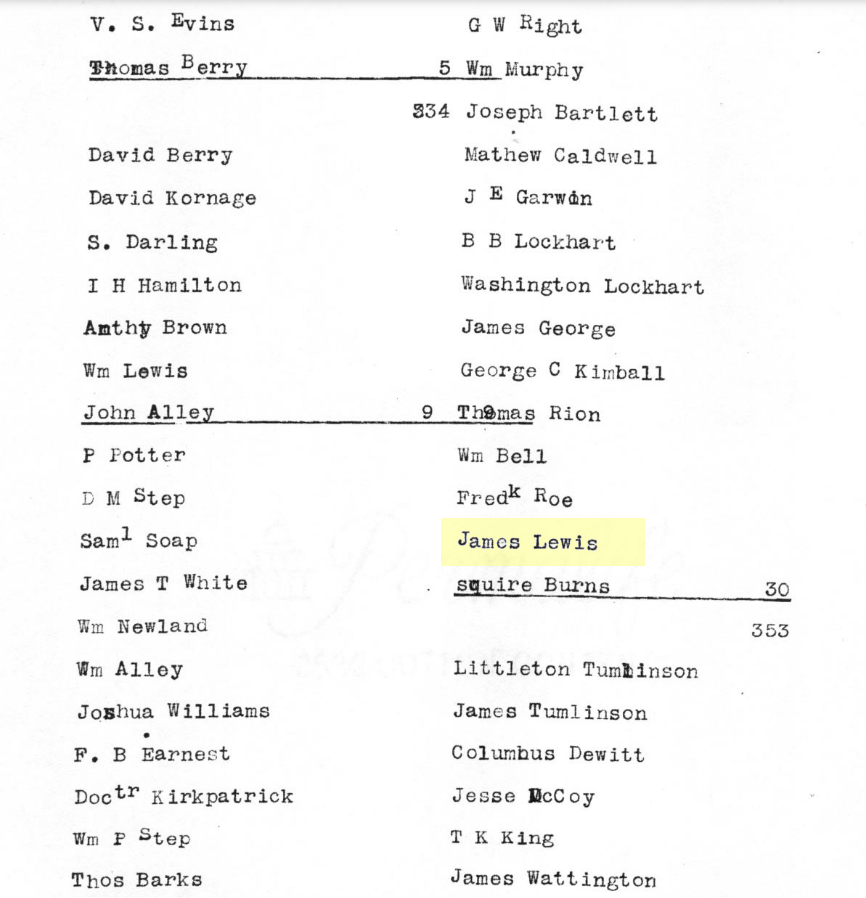
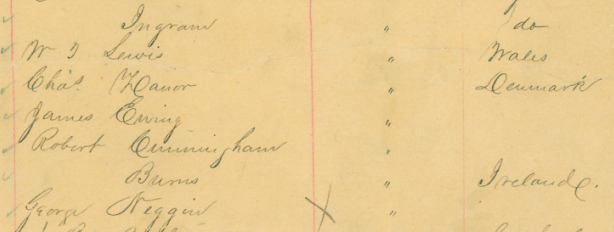
- A document entitled "List of men who have this day volunteered to remain before Bexar" contains the names of 403 men who were in the Texian militia as of November 24, 1835. This is the date that Edward Burleson was elected as general of the volunteer army, replacing Stephen F. Austin, who the provisional government appointed to be a commissioner to the United States. The portion of this list where Lewis's name appears is shown in Figure 1, above. Most of the men whose names are listed above and below Lewis's are known or believed to be settlers of DeWitt's Colony or residents of its capital, the town of Gonzales. These men include Matthew Caldwell, John E. Garvin, Byrd B. and Washington Lockhart, James George, George C. Kimball, Frederick Rowe, Squire Burns, James and Littleton Tumlinson, Columbus DeWitt, and Jesse McCoy.
- Figure 2, Captain John York's muster roll from November 1835, shows the name James Lewis on line 31 of the first column. Many of the same men whose names surround Lewis's on the previous list are also on this roll.
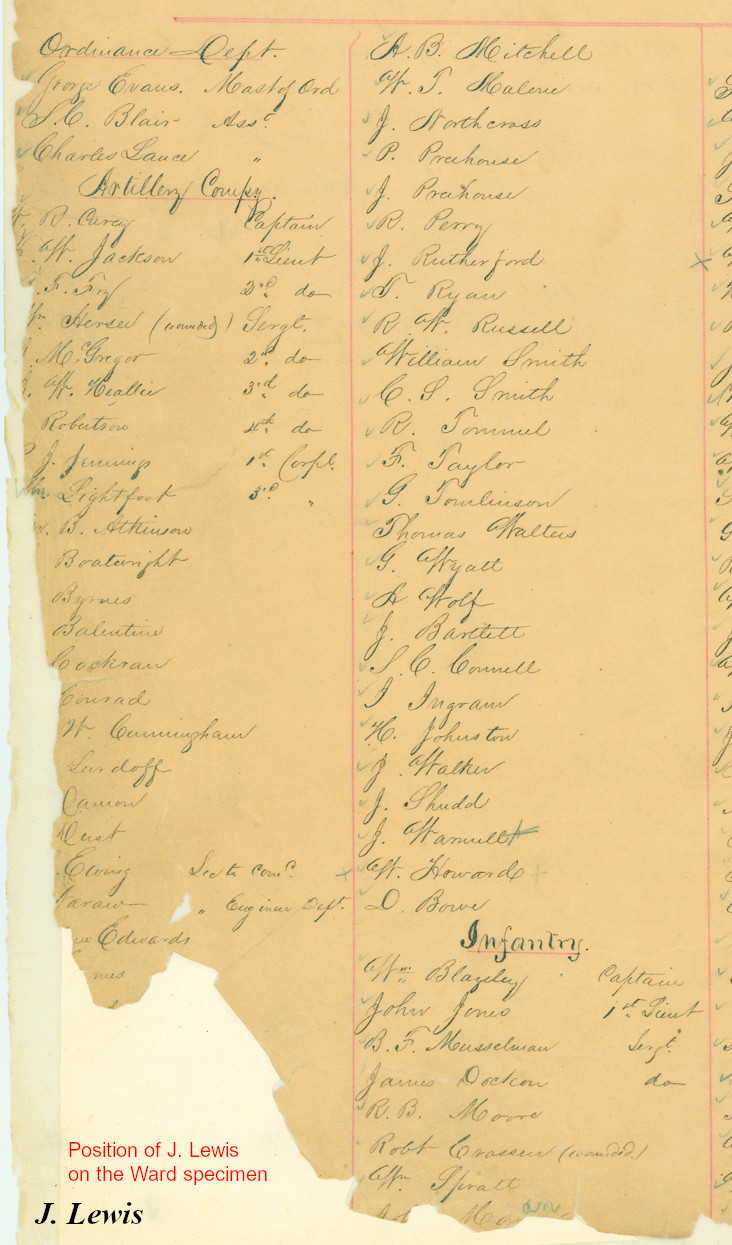
- James Lewis is on Colonel Neill's muster roll as a private in Captain William R. Carey's company. The heading on this document implies that it was made in mid-February 1836, but historical analysis shows it was actually made in the first week of January. The name, as shown in Figure 3, is written here as J. Lewis. It should be noted that most of Lewis's DeWitt's Colony neighbors in the militia went home after the Battle of Bexar. Some did, however, return to Bexar to reinforce the Alamo on March 1 as part of the Gonzales relief force.
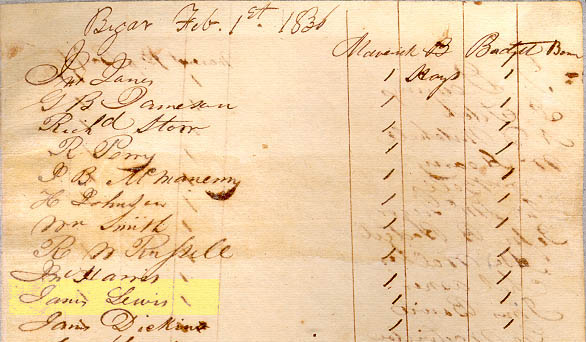
- The voting roll from the Texian garrison's election for delegates to the General Convention, dated February 1, 1836, shows James Lewis as the name of the tenth voter, as shown in Figure 4. For more information about this document, see our article, "Alamo Personnel - February 1, 1836 Voting Roll."
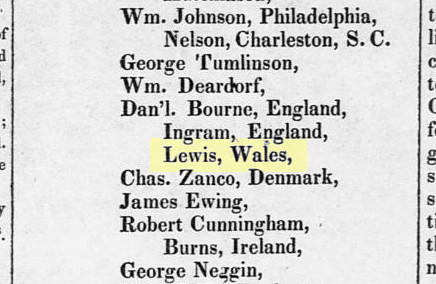
In addition to the above four documents placing James Lewis in the Texian militia at San Antonio prior to the siege of the Alamo, there is documentary evidence for his death at the Alamo that dates shortly after the battle. The March 24, 1836 edition of the Telegraph and Texas Register of San Felipe featured a list of Alamo casualties. This was the first Alamo casualty list to be published. It contains 115 names. For 46 of the men, a surname, first name or initials, and place of origin or residence are given. The Telegraph's editors did not have all of this information for the others, but they printed what they had for each man. James Lewis is represented as "Lewis, Wales," with no first name, as shown in Figure 5.
Lewis is and was a common name, though. The "list of men," for example, has three Lewises on it, counting James, and the full set of Battle of Bexar muster rolls contains several more. How can we know that "Lewis, Wales" was James Lewis and not one of these others, or a man who arrived at Bexar after the December battle? While it is true that the connection between James Lewis and "Lewis, Wales" cannot be proven, there are sound reasons to connect them. First, we can eliminate many of the other Lewises, because we know exactly who they were and what happened to them. The subset of Lewises who conceivably could have died at the Alamo is small. Second, James Lewis is the only Lewis on either Neill's roll or the voting roll, and he is on both. This makes him the only man named Lewis who is documented to have been in Bexar between the Battle of Bexar in December 1835 and the beginning of the Alamo siege on February 23. Third, there is no record of James Lewis ever leaving Bexar. Colonel Neill, Captain Carey, and the other officers gave discharges to the men who left their commands, so that they could get paid for their service. The Texas State Library in Austin still has these discharges in its archives. They exist for a dozen or more men who left Bexar in between Neill's muster roll and the beginning of the siege, but there is no such discharge on file for James Lewis. So, if the "Lewis, Wales" who died in the Alamo battle was not James, then we have to ask not only who "Lewis, Wales" was and when did he arrive at Bexar, but also what happened to James Lewis, when did he leave Bexar, and why is there no evidence of his departure?
As much as we might prefer to think otherwise, ironclad, indisputable evidence that a man died at the Alamo only exists for a small handful of cases. For all the others, we weigh and analyze the evidence we have and make an informed conclusion. Taking that approach, James Lewis should be an obvious inclusion on Alamo casualty lists. Probably half of the men who have been on these lists for the past nearly 200 years are not as well-documented as he is.
Erasure Begins
The Republic of Texas offered land grants to Texas Revolution veterans and their heirs. After the Revolution was won, the government compiled the muster rolls and other records of the various military companies so that it could verify claims. A claim came in from one Mary Irvine Lewis of Philadelphia regarding her son, William Irvine Lewis. As with many other parents, siblings, and other relatives in the United States, Mrs. Lewis did not know what happened to her loved one; she only knew that he went to Texas, there was a war, and she had not heard from him. Texas officials investigated the muster rolls and found a match: the list identified as Muster Roll 117 contains an entry for "W. J. Lewis, 28, Pennsylvania." The incorrect middle initial was not considered important, for the cursive capital I and J look similar in many people's handwriting. But being on Muster Roll 117 was a bad sign. This was the roll of Captain H. S. Kimble's company.1 There are only thirteen names on this roll, and ten of them were Alamo victims—eleven, including Lewis. Kimble and his men swore allegiance to the provisional government of Texas in Nacogdoches on January 14, 1836 and then began making their way to San Antonio de Bexar. Kimble himself did not go, instead returning home to Tennessee, but most of his men went on without him. It is often said, without any evidence, that they entered Bexar with David Crockett. Whether they did or did not, they probably arrived at about the same time as he did, on about February 9 or later. On the basis of this muster roll, the Secretary of War approved Mrs. Lewis's land grant claims on August 28, 1838. The grant certificates recognize William Irvine Lewis as a soldier who died in the Alamo on March 6, 1836.
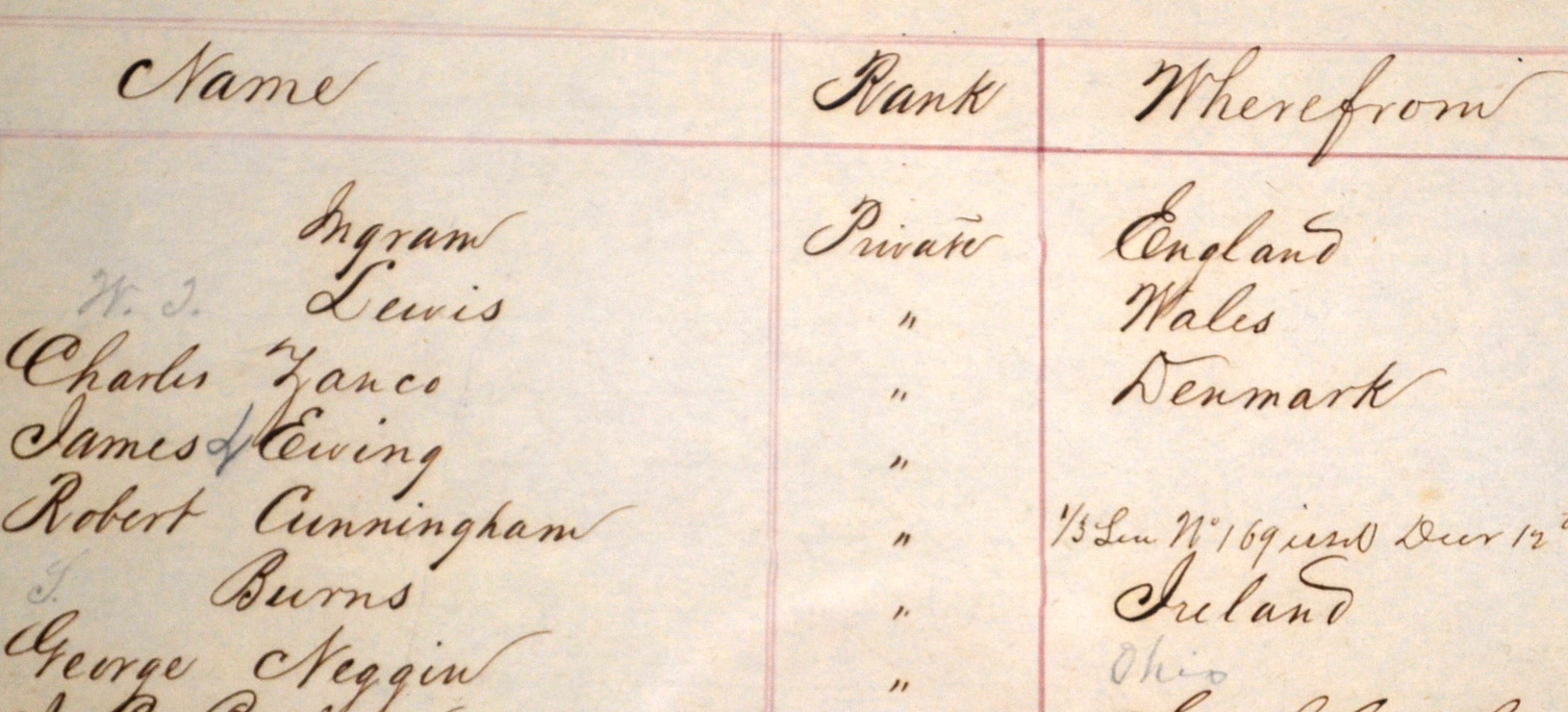
It was the adjutant general's responsibility to maintain the records and to recommend to the Secretary of War whether or not a claim should be granted. In addition to the muster rolls, the adjutant general kept his own Alamo casualty list. His list started with the one printed in the Telegraph and Texas Register, with a few names then added, a few removed, and some details added, such as first names or initials. Today, two specimens of the adjutant general's list survive. They are both in the archives of the General Land Office and are often referred to as the GLO casualty list. The earliest specimen, called MR1, had the initials W. I. (some people see W. J. or W. T.) added in front of Private Lewis from Wales in pencil. The final list, which was finished in 1839, had those initials written in ink as part of the name. (See Figures 6 and 7, right.) We do not know whether the person or people who made this edit had seen Captain York's muster roll, Colonel Neill's muster roll, or any of the other evidence that there was a James Lewis at the Alamo. We do not know how much thought they gave to the fact that William I. Lewis was said to be from Philadelphia, not Wales. But they took James Lewis's spot on the Telegraph casualty list and gave it to William I. Lewis. The erasure of James Lewis as an Alamo defender had begun.
Is it possible that William Irvine Lewis was Lewis of Wales? No. Genealogical research on his family shows that he was a third-generation native American. His paternal grandfather was born in Ulster, Ireland and came to the U.S. as a child. Lewis's parents were born in the U.S. He had no Welsh ancestry. Furthermore, one must consider the manner in which the Telegraph casualty list was compiled. Its two principal contributors were John W. Smith and Gerald Navan. Smith was a well-known Alamo messenger. He guided the Gonzales reinforcement party into the compound on March 1, 1836 and carried messages out for Colonel William Barret Travis on March 3. He was also a resident of San Antonio de Bexar and was with the Texian militia in December. Navan was a member of the garrison who Neill apparently sent out to procure provisions in late January. Between them, they would have been well-acquainted with all of the men who had been in the Alamo since mid-December, those who arrived in January, and those who arrived from Gonzales with Smith on March 1. Smith would have only had about a two and a half days to get to know the thirty or more men who arrived in February, however, and Navan would not have known them at all. The editors of the Telegraph and other residents of San Felipe knew the residents of Austin's Colony and other men who passed through San Felipe on their way to Bexar. No one who worked on the Telegraph list would have known the men who took the volunteer oath in Nacogdoches and marched to Bexar, though. For the most part, those men traveled via Washington-on-the-Brazos and Bastrop, bypassing San Felipe. They were unknown to the compilers of the Telegraph casualty list, outside of whatever contact Smith had during his relatively brief time with them. That is why, of the eleven men on Kimble's muster roll who known or are believed to have died at the Alamo, none are on the Telegraph casualty list. The Telegraph's Lewis of Wales could not have been William Irvine Lewis.
Two Lewises
While the adjutant general, Secretary of War, and General Land Office were busy awarding land grants to the heirs of fallen Alamo soldiers, other Texans were identifying Alamo victims for a different reason: to pay their respects. In 1841, the first monument to the Alamo was made from stones taken from its ruins. On this ten-foot-tall structure were inscribed the names of 162 men who the makers believed were killed in the Battle of the Alamo.2 The makers of this monument used other sources besides the Telegraph casualty list and adjutant general's list to compile their names. They included most of the names on the Telegraph list, but not all, and added many new names. The names on the monument were just surnames and initials, or surnames alone, with no added information. Some surnames were carved twice, three times, or more. This monument had two men named Lewis. In many cases where names appeared multiple times, there were first initials to distinguish them—for example, E. Taylor, G. Taylor, J. Taylor, and W. Taylor—but the two Lewises had nothing to distinguish them—that is, they were both written simply as Lewis.
Seeing the same surname carved twice on an Alamo monument should not raise a red flag. For example, there actually were four men named Taylor who died at the Alamo. In that instance, three of them were brothers, but there were also three Nelsons, none of whom were related.3 The names that were shared were not always common ones, either: there were two unrelated Ballentines and probably two unrelated Holloways. In fact, about one quarter of the Texians who died in the Battle of the Alamo shared a last name with another Texian who died there. Our instinct, then, upon seeing an Alamo list with two Lewises should not be to assume that the listmaker accidentally duplicated the name; our instinct should be to investigate why the maker of the list believed there were two men named Lewis.
The 1841 monument represents the members of Captain Kimble's company fairly well. If we assume that one of its Lewises is William, then it bears the names of eight of Kimble's men: Micajah Autry, James P. Bailey, Joseph Bayliss, Robert Bowen, Daniel Cloud, William I. Lewis, Richard L. Stockton, and B. A. M. Thomas. None of these men are on the Telegraph list. It is entirely possible, then—some might argue probable—that one Lewis on the 1841 monument was meant to represent William, while the other was James. Since no initials were carved, the maker would have known them as the Lewis who was from Wales and who fought in the Battle of Bexar and the Lewis who arrived from the Pennsylvania in January and traveled to Bexar via Washington and Bastrop.
The list of names carved on the 1841 monument was not printed in a newspaper or book until decades later. The only way a person could know what names were on the monument was to go and look at it. Published lists, therefore, ignored the monument and instead relied almost entirely on the Telegraph and adjutant general's lists. The first list compiler to use the 1841 monument as a source was former Governor Elisha M. Pease, in 1876. One of the things Pease did was check for duplicates. He removed one of the Lightfoots and one of the Wilsons, and in doing so, he was correct. He could have gone further and removed a Jackson, a Nelson, two Smiths, and another Wilson, so he did not catch all of the duplicates. His list had two Lewises. Like the monument, he did not provide first names or initials for either one.
It is notable that Pease did not know the first name or initial of either Lewis. William Lewis, especially, should have been easy to identify. Not only were his initials on a muster roll, but the Republic of Texas government's gift of a custom-made memento to his mother in response to her letters had been a published news story in 1840. The initials W. T. Lewis were printed in the 1860 Texas Almanac, which used an edited version of the adjutant general's list. Perhaps Pease was concerned about the notation that this Lewis was from Wales, a claim he might have suspected to be inaccurate. Or, perhaps he did not know which roll to trust and which middle initial to believe—I, J, or T—and avoided writing anything down for that reason.
The reason for not knowing James Lewis's first name could be simpler. In 1855, a fire destroyed most of the files in the adjutant general's office, including the muster rolls. Fortunately, the General Land Office had copies. Unfortunately, the GLO's copy of Neill's muster roll suffers from a tear that completely or partially removes about twenty names. J. Lewis is one of the names that is completely missing (see Figure 8). On what date this damage occurred is unknown, but it could explain not only why the first name or initial of Lewis of Wales was always elusive, but also why later researchers came to believe that William I. Lewis was the only Lewis at the Alamo. The specimen of Neill's muster roll sampled in Figure 3 was in a private collection and unknown to Alamo researchers until the early 1990s. (For more information, see our article, "Alamo Personnel - Colonel Neill's Muster Roll".)
The Alamo monument built in 1841 was ruined in a fire in the state capitol in 1881 and was subsequently dismantled. A new monument was constructed in 1891. Named "Heroes of the Alamo," This granite memorial still stands on the grounds of the capitol today. It includes two Lewises. The names are carved as LEWIS, W. and LEWIS, W. G. Since the cursive capitol G looks nothing like an I, it is assumed that W. Lewis is William (with the pesky, inconsistent middle initial omitted), while W. G. Lewis is someone else. The only known Texas soldier with that name, William G. Lewis, served in 1837 and definitely did not die in the Alamo. This monument, therefore, does not help to identify James Lewis, but it does maintain the belief that two men named Lewis died at the Alamo; that the two Lewises on the 1841 monument and Pease's list were not an erroneous duplication. James Lewis's name had been torn off of one roll and his spot given to William on another, but he had not yet been completely erased.
The Alamo casualty lists discussed above are not the only ones that were published in the 19th century. They are mentioned and discussed here because each of them showed a significant amount of independent research. They were not just copies or slightly edited versions of earlier lists, such as the one in the 1860 Texas Almanac. The next such list worth mentioning was compiled by Frank Templeton and published in 1907 as an appendix to his Alamo romance story, Margaret Ballentine. Templeton's list has 178 names. He includes a greater number of first and middle names and initials than any previous list, and also includes two columns to say where each Alamo defender was from: one for his birthplace, and another for last place of residence. Templeton was the first listmaker to provide ages for the men. Templeton did not disclose how he did his research or where he got his information, but to put it bluntly, it is not a good list. He added many names that had never appeared on any earlier list and have not appeared on any list since, many of his first names and initials are wrong, and his birthplace, origin, and age information is extremely unreliable. That being said, he has two Lewises: J. W. Lewis from Pennsylvania, and W. G. Lewis from Wales. Templeton saw the two Lewises on the previous lists and did not take them to be duplicates of each other. To his credit, he got their origins correct, even if he got their names entirely wrong.
The Alamo casualty list printed in the March 24, 1836 Telegraph and Texas Register was the first such list to be published, but it was not the first list to be made. William Fairfax Gray was a Virginia lawyer who came to Texas on a business trip but found himself in the middle of a revolution. He was at the General Convention on Washington-on-the-Brazos on March 16 when John Sutherland Jr. arrived and confirmed the rumor: the Alamo had fallen. The delegates quickly finished their business of setting up a new government and adjourned. The interim government began retreating eastward along with the rest of the population of Texas. On March 20, Colonel Travis's slave, Joe, arrived at Groce's retreat and gave his eyewitness account of the Alamo battle to the members of the government. Gray had been keeping a journal since leaving Virginia, and on that day's entry, he made the first Alamo casualty list. Line 85 on that list reads, "____ Lewis, Philadelphia." This was, obviously, William I. Lewis. Captain Kimble and his men had passed through Washington in late January on their way to Bexar from Nacogdoches. They stayed with Washington homeowners on their way through, and a few of them signed receipts for the lodging, food and horse fodder they were given. Gray's casualty list included Kimble and eight of his men. Evidently, Washington is where Kimble and his men parted ways, and the residents of Washington were unaware that he did not continue to Bexar with his men. Gray's casualty list does not include a second Lewis. This list was unknown until the publication of Gray's journal in 1909 under the title From Virginia to Texas.
One Lewis
Because of an incorrect edit to the adjutant general's Alamo casualty list and a torn muster roll, James Lewis's name eluded researchers, but one thing most of them agreed upon as late as 1907 was that there were two Lewises at the Alamo. The next person to take an independent look at the Alamo list was Amelia Williams, a history student at the University of Texas. Williams wrote her doctoral dissertation, "A Critical Study of the Siege of the Alamo and of the Personnel of Its Defenders," in 1931. Much more than just a list of names, this 457-page thesis took Alamo personnel research to an entirely new level. An edited version of Williams's dissertation was published in parts in the Southwestern Historical Quarterly in 1933 and 1934. Her Alamo biographies appear in Volume 37, April 1934. For her research, Williams reviewed hundreds of documents in the General Land Office, the Texas State Library, the Daughters of the Republic of Texas Library, and elsewhere. She also reviewed all of the casualty lists that have been discussed above. With regard to Lewis, however, she mentions only one of the earlier lists: the Heroes of the Alamo monument built in 1891. Noting that it has two men named Lewis, Williams writes, "The documents show that only one Lewis died at the Alamo."4 She then writes a biography of William Irvine Lewis which states that he was a native of Wales who immigrated to Texas from Pennsylvania.
Williams's assertion, "The documents show that only one Lewis died at the Alamo," is highly problematic. This is not a statement that a researcher can make using documents that do not purport to be complete and comprehensive. The Telegraph editors did not claim that their Alamo casualty list was complete: they knew it was not, and explicitly wrote, "as we obtain more [names] we will publish them." Gray stated that his list included the Alamo victims "as far as they are known."5 The Secretary of War and General Land Office used the adjutant general's list as a starting point, but issued many Alamo land grants to men whose names were not on it, because they were highly aware that it was incomplete. None of the documents Williams reviewed stated that there was only one Lewis at the Alamo, and she had no right to declare that they did. She concluded that there was only one Lewis and then foisted her conclusion into the documents.6 And it was an incorrect conclusion. As shown above, William Irvine Lewis was born in Virgina and had no Welsh ancestry, and it is impossible for the man who was on York's and Neill's muster rolls in November 1835 and January 1836 to have sworn a volunteer oath in Nacogdoches on January 14.
In light of the documentation available to her at the time, Williams could have been forgiven for not knowing James Lewis's first name. She could have even been forgiven for taking the inclusion on some lists of an Alamo defender named Lewis from Wales as a mistake. But, if she believed that there was an Alamo defender from Wales named Lewis, she should have seen that he was not William I. Lewis, and she should not have swept under the rug the fact that the 1841 monument, Pease, and Templeton concurred with the 1891 monument's assertion that there were two Lewises.
Researchers and historians subsequent to Williams have made edits to the list she published in 1934. A study done by the Daughters of the American Revolution in 1976 reprinted most of the Alamo defender biographies in "A Critical Study" verbatim, while adding genealogial information about many of the Alamo defenders. Their information proves that William Irvine Lewis was not Welsh. But, instead of revisiting the idea of two Lewises, the DAR edits Williams's bio of William Irvine Lewis to omit any mention of Wales. Likewise, the biographies of William I. Lewis in the three most often-referenced Alamo resources today—Bill Groneman's Alamo Defenders (1990), the Texas State Historical Association's Handbook of Texas, and the official Alamo web site, thealamo.org—lack any mention of Wales. None of the sources presented in Figures 1 through 5, above, are used or discussed. The erasure of James Lewis is complete.
Conclusion
Muster rolls and other documentation from late 1835 and early 1836 show that James Lewis of Wales was with the Bexar garrison continuously from November 1835 through February 1836. These documents further show that William Irvine Lewis of Philadelphia joined the Texian army at Nacogdoches in January 1836. Each man appears on an Alamo casualty list prepared in March 1836, but they are identified by their places of origin instead of their first names. The compilers of Alamo casualty lists from 1841 through 1907 recognized that two men named Lewis died at the Alamo. In 1931, Amelia Williams identified William I. Lewis through land grants and an old newspaper story, but did not find documentation of James. She irresponsibly declared that the documents show that only one Lewis died at the Alamo. Her biography of William I. Lewis nevertheless contains a hint of a second Lewis via her reference to him being born in Wales. Subsequent researchers removed even that element, leaving us with no trace of the second Lewis. Since Williams's Alamo biographies were published, three documents from 1835 and 1836—the November 24, 1835 roll of Burleson's army, the Bexar garrison voting roll, and an intact specimen of Neill's muster roll—have been discovered. These documents show that the makers of the 1841 monument, Elisha Pease, the makers of the 1891 monument, and Frank Templeton were all correct: there were two Alamo defenders named Lewis, but one of them had been erased. His first name was James.
By David Carson
Page last updated: May 21, 2026
1This man is not to be confused with Lieutenant George C. Kimball, an officer in the famous Gonzales relief force.
2Historian Reuben M. Potter wrote in 1871 that he believed the list of names was curated by "Mr. Sutherland, then well known as a member of Congress of Texas from the lower Colorado." That would be George Sutherland, a veteran of the Battle of San Jacinto, member of Congress in 1837 and 1838, brother of Alamo writer and purported messenger John Sutherland Jr., and uncle of Alamo victim William D. Sutherland.
3An oft-repeated claim that Edward and George Nelson were related has never been substantiated.
4Williams, p. 294.
5Gray, p. 188.
6Sadly, this is something she did routinely, and is one of many reasons why "A Critical Study" has been an enormous stumbling block to all subsequent Alamo historians.
- Bexar Bounty 184
- Bexar Donation 183
- "More Particulars Regarding the Fall of the Alamo," Telegraph and Texas Register (San Felipe), March 24, 1836.
- Baker, D. W. C., A Texas Scrap-Book, 1875.
- Daughters of the American Revolution, The Alamo Heroes and their Revolutionary Ancestors, 1976.
- Gray, William F., At the Birth of Texas, 2015.
- Jackson, Ron, Alamo Legacy, 1997.
- Potter, Reuben M., letter to William Steele, 7/10/1874. In Hansen, Todd, The Alamo Reader, 2003.
- Templeton, Frank, Margaret Ballentine, 1907.
- Williams, Amelia, "A Critical Study of the Siege of the Alamo and the Personnel of Its Defenders," Southwestern Historical Quarterly vol. 37, April 1934, pp. 237-312.